

The lynx is the part I kept rewinding. In Prada's holiday film it pads across a snowfield beside Sadie Sink, and every so often its outline shivers, the small tremor a drawing makes when someone has traced it again on the next sheet of paper. I wasn't looking at the coat, or the bag, or even at Sadie Sink. I was looking at the wobble, and underneath it, without quite admitting it to myself, I was looking for the person who had drawn it.
I wasn't the only one looking. This holiday season, a lot of us went through luxury's Christmas films the way you go through a drawer for something you've lost, and for once the houses seemed to know exactly what we were looking for.
The year luxury put down the prompt
It had been building all year. In February, Gucci promoted its Milan show with images labelled "created with AI", and the reaction was close to contempt: people wanted to know why a house that could hire any photographer in Italy couldn't find a real Milanese grandmother. Valentino had been through something similar the December before. Meanwhile, other houses were quietly going the other way. Loewe marked its 180th anniversary with a film painted by ten artists on more than two thousand sheets of watercolour paper. Hermès handed its website to the illustrator Sarah Martinon. Chanel opened its Métiers d'art collection in Seoul with drawings by Jisu Choi.
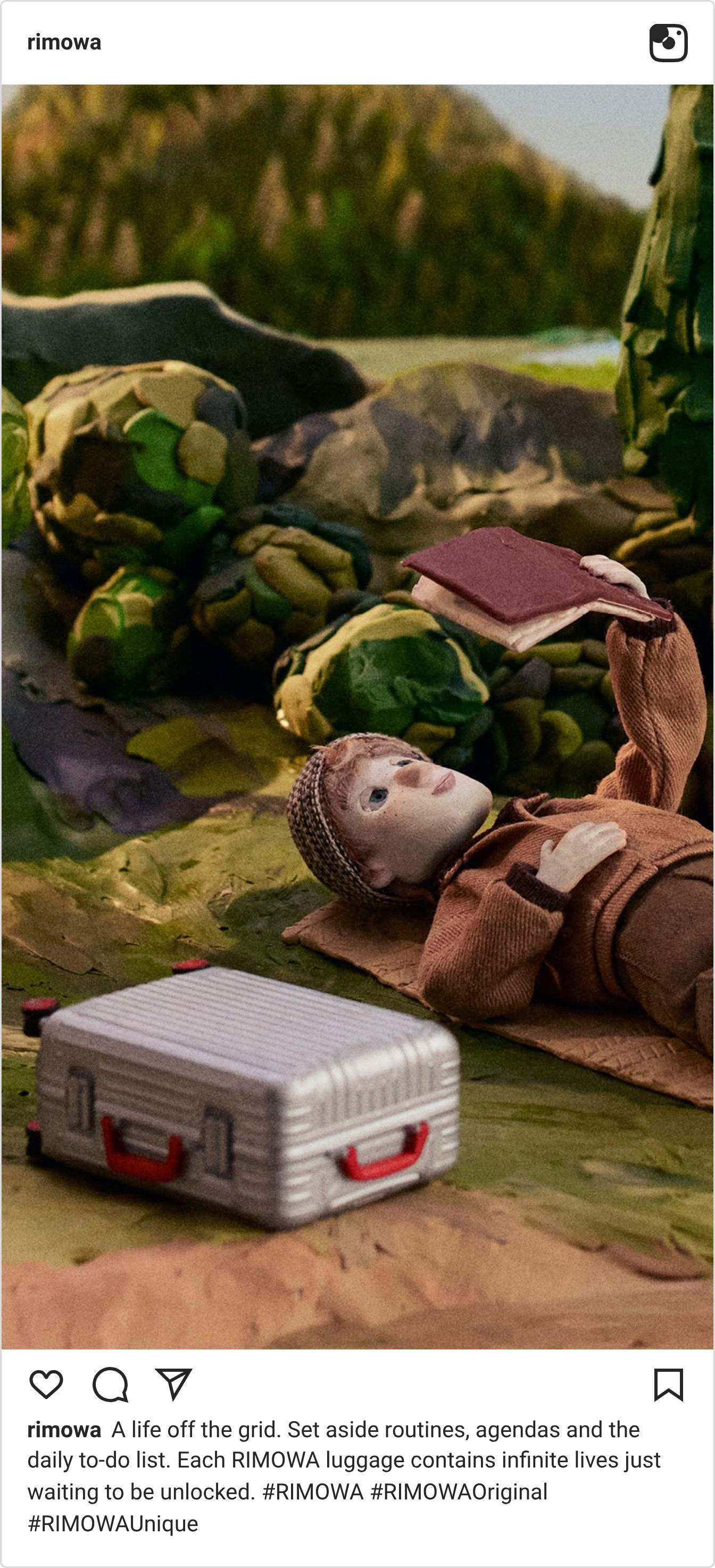
By the time the Christmas campaigns arrived, the drift had become a direction. Prada drew its holiday by hand. Dior commissioned a six-minute animated film from one of the great living hand animators. Rimowa built tiny worlds out of clay, paper, felt and wood inside its aluminium suitcases and set them moving in stop-motion. Even Levi's, a long way from the Place Vendôme, made its holiday film in stop-motion, one frame at a time, and told the press it had taken around two thousand hours. In the season when brands most want us to feel something, they reached for the one thing they couldn't generate.
Prada let us watch
Drawing Prada: Animated by Hand arrived at the end of October, and it is the most joyful thing a luxury house has made this year. Mice steal Sadie Sink's shoe and carry it into a hole in the skirting board. Bats hang a Prada bag in a snowed-in cabin. A fox with a deadpan, deeply unimpressed face keeps Maya Hawke company, and the lynx pads through the snow.
The animation is directed by John Pomeroy, who joined Disney as a trainee in 1973 and spent the next five decades drawing films many of us grew up inside: The Fox and the Hound, The Land Before Time, Pocahontas, Fantasia 2000. With Don Bluth and Gary Goldman he also co-founded the studio that made The Secret of NIMH, a whole feature about a widowed field mouse, which makes the mice in this campaign feel less like a coincidence than a signature. His team includes the Disney veterans Tom and Tony Bancroft. Around them, Miuccia Prada and Raf Simons set the creative direction, Ferdinando Verderi led the campaign, and Glen Luchford photographed Sink, Hawke, Kelvin Harrison Jr., Chen Haoyu and Luther Ford, matching his light and perspective to the drawn worlds so that the people and the pencil seem to share the same air.
What makes it brilliant isn't only the drawing. It's that Prada showed us the drawing. Alongside the film came a behind-the-scenes video of the artists at work, pencil sketches, and exposure sheets with Pomeroy's handwritten frame numbers in the margins. Prada hasn't said how many hours it all took, and it didn't need to, because you can see them. In the behind-the-scenes film, Pomeroy says he learned his craft with pencil and paper, and that he wants the work to show that hand-drawn craft is still alive. The comments under the campaign were, for once, almost entirely kind, and many of them thanked the artists.
This is the same house whose spring campaign, made with the artist Jordan Wolfson and a crew of around fifty people, was dismissed online as AI slop because its strange winged creatures looked like something a machine could make. Eight months later, Prada didn't just tell us that people had made its Christmas. It let us watch them do it.
Dior drew it too, and the internet didn't believe it
Dior's film is beautiful, which is what makes the next part so uncomfortable. Christian Dior's Night in Color premiered in the first week of November, directed by Sylvain Chomet, the Oscar-nominated animator behind The Triplets of Belleville and The Illusionist. It imagines a winter night in 1949 when Marlene Dietrich asks her friend Christian Dior for a new gown, and he works until morning on a dress inspired by the house's Junon. Robert Pattinson narrates, and the voice cast includes Rihanna, Josh O'Connor, Greta Lee, LaKeith Stanfield, Louis Garrel and Camille Cottin. Jonathan Anderson described it as entirely hand-drawn, using techniques that go back to the 1940s.
Within days, people were pausing it frame by frame. On Reddit and Instagram they posted stills of warped lettering, faces that seemed to shift between frames, a misspelled name on the tag of Dior's dog and, most famously, a hand that appeared to have six fingers. Others pointed to something harder to screenshot: movement that felt unusually smooth, too fluid for drawings made one at a time.
Chomet answered in an interview with Variety. Everything was drawn by hand, he said, and the six-fingered hand was an open, fanned hand drawn to suggest movement. His producer, Aton Soumache, described seven months of production and around twenty people, six of them animators, who drew the characters, the backgrounds and the key poses. Then he added the detail that has kept the argument alive: an automated interpolation system had been used for a very small part of the process, generating some of the in-between frames. Dior itself has not commented publicly.
Nothing anyone has found proves that generative AI was used. But the interpolation may explain why the suspicion settled where it did. In traditional animation the key poses are the big decisions, and the in-betweens are where an animator's hand lives: the hundreds of small drawings that carry a character from one pose to the next and give movement its weight and its wobble. That is the part viewers felt was missing. They weren't really counting fingers. They were looking for the person between the poses, and in places they couldn't find one.
What the hand carries
Put the two films side by side and the lesson isn't that one house told the truth and the other didn't. Both hired masters, both films took months of human work, and both are lovely. The difference is how much of the hand we were allowed to see. Prada brought us into the studio. Dior told us the film was hand-drawn and asked us to take its word, and in 2026 a word isn't enough.
Luxury has always understood this about objects. The hallmark stamped into silver, the saddle stitch you're invited to run your thumb along: these were never only guarantees of quality. They were traces of the people who made the thing, a way of telling you that someone sat with it. Psychologists have even measured the pull. In studies published in 2004, people rated the same poem more highly when told it had taken eighteen hours to write rather than four. What's changed is that we now want that trace from images too. This Christmas we stopped asking only whether we wanted what was in a campaign, and started asking who was in it, in the other sense: whose hand, whose time, whose choices.
The artist at the desk
Which brings me back to the lynx, and to what I was really doing when I rewound it. I thought I was checking whether it was real. But somewhere behind every one of those drawings there is a person at a desk, deciding, again and again, exactly where an animal's shoulder should fall, and that, it turns out, is what I wanted to find. When everything can be generated, the rarest thing a luxury house can offer at Christmas is proof that somebody cared enough to make it slowly.

