

Sydney Sweeney is lying naked across a pool table telling me that you can't trade this, she just looks good here. The ad is forty-two seconds long. I watched it on a Thursday morning with my coffee going cold and I was tired before it finished.
It did what it was built to do. By the weekend it was a national argument, and by Monday the only question left was how well it had worked.
We already know the answer to that, because we ran the experiment fourteen months ago. The American Eagle campaign turned a homophone into a fight about eugenics and ended with the President of the United States offering an opinion on denim, and then sales went up. Nobody has that accident twice. The people who commissioned this one had the numbers from the first one in front of them.
The body is the packaging
The spot is for Novig, a sports prediction market that went live nationwide last month and is competing for share in what the industry is cheerfully calling a gold rush, timed to the start of football season. Sweeney comes in as a strategic partner and equity holder rather than a hired face, which means she is paid in the upside of how many people look. She is nude or close to it throughout, using footballs, a bat, a racket, protective padding as the only covering, and the line she keeps returning to is that Novig is just sports, so they wanted to show just sports. The Instagram reel passed thirty-seven million views in four days. It has not slowed down since.
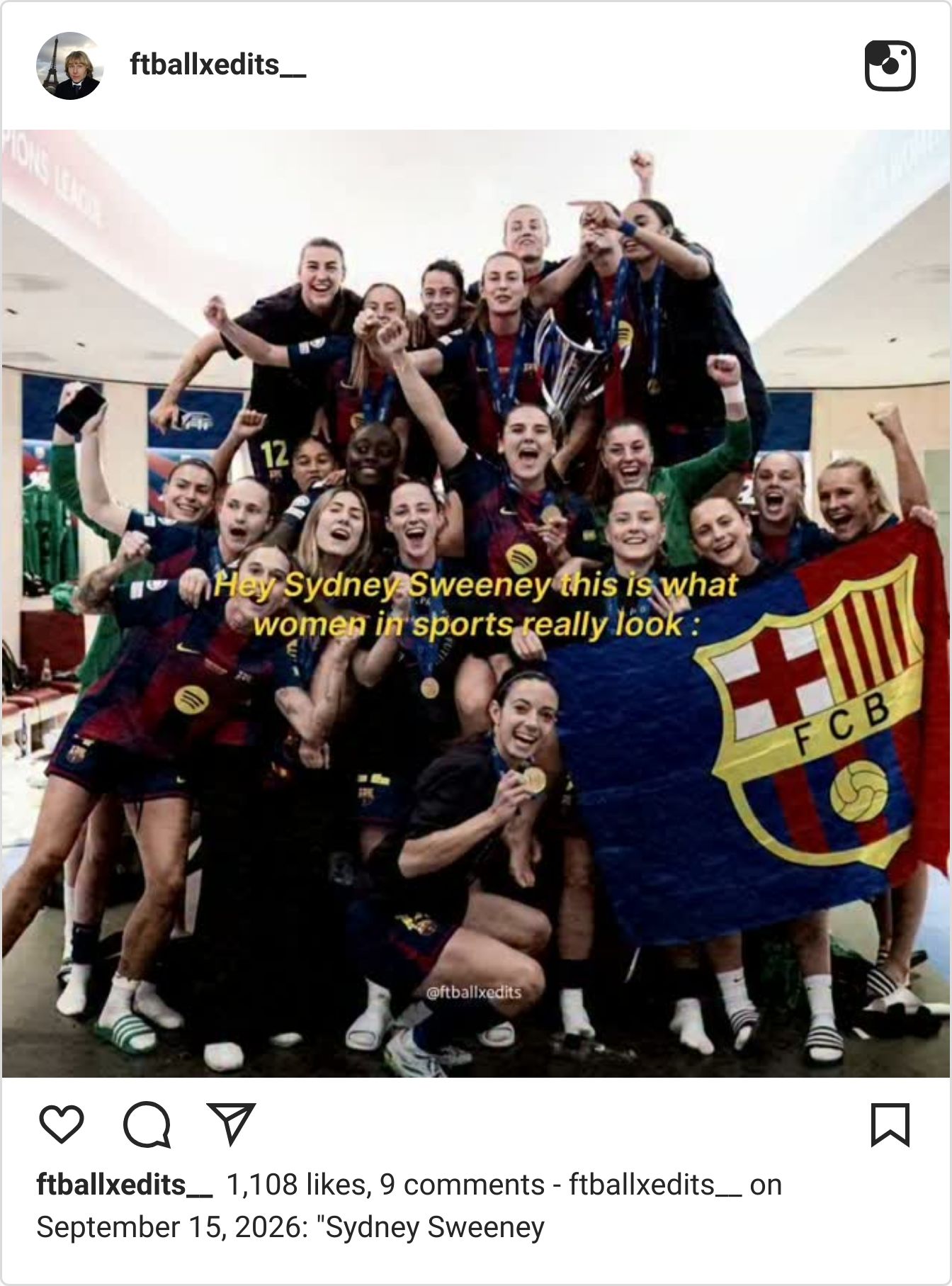
The response from women in sport was immediate and unusually organised. Ariarne Titmus, who has four Olympic golds and no obvious need to pick fights on the internet, wrote that she could not describe how infuriated the ad made her. Tilly Kearns posted water polo footage — the churn of it, hair flattened to her skull, somebody's elbow going somewhere it shouldn't — with a caption saying plainly that she hated Sydney Sweeney's new sports ad, and here was some real women's sports content instead. Amy Hunt, Gracie Kramer, Felicity Palmateer, Lani Pallister, Bree Masters and the Australian Institute of Sport all followed within days, and almost every one of them did the same thing: answered an image with footage. Training at six in the morning. A race. A tackle. Palmateer told CNN the campaign was damaging for girls coming into sport. The Female Athlete Project noted how much contempt Novig had managed to compress into well under a minute.
Sweeney's reply, delivered obliquely on Sunday through a carousel rather than a statement, was a run of ESPN Body Issue covers: Serena Williams, Ronda Rousey, Sue Bird, Megan Rapinoe, Caroline Wozniacki. The implied argument is that the nude female athlete is a settled and even celebrated form, so what exactly is the complaint.
It is a decent argument and it is wrong, and Titmus had already answered it before it was made. There is a difference, she wrote, between looking good because of what your body does and using a body to sell something that has nothing to do with it. In the Body Issue the athlete is the subject of the photograph. Her shoulders mean something. The asymmetry in a swimmer's back is the information. Serena's body was the argument the picture was making. In the Novig spot the body is packaging, and the thing inside the packaging is a gambling product.
Novig is just sports
It took me until the third watch to notice that the nudity is the least interesting thing in it.
Watch it again and listen to the words. Novig is just sports. The script spends its first seconds listing what the product supposedly has nothing to do with — politics, wars, deaths — before landing on you and your take. The whole thing is a positioning statement, and a defensive one. Prediction markets are in a live, expensive fight to be understood as financial exchanges rather than bookmakers — to be called trading, never betting. Sweeney uses the word bet exactly once, and only to describe what the other guys do. Meanwhile a Betterment survey this year found that just over half of Gen Z investors had moved money earmarked for investing into sports betting instead.
That is the claim the ad is making. It is the only claim with money riding on it. And for a full week, in the middle of the loudest advertising conversation of the month, almost nobody argued with it.
This is what the body was for. Titillation is cheap and available everywhere; what Novig needed was absorption. A nude woman on a pool table takes one hundred per cent of the oxygen in any room she is placed in, which means the sentence she is saying walks out of the room unexamined. The most efficient thing an advertisement can do in 2026 is hand you something to be furious about that isn't the thing it needs you to accept.
And the fury, once supplied, does the distribution. Every duet, every stitched training reel, every news item, Bobbi Althoff's parody, this essay: all of it is Novig's media plan executing on schedule and at no cost. The athletes made the best case for women's sport that anyone made this month — genuinely, the footage was extraordinary, the argument unanswerable — and they made it inside the campaign that had insulted them. Outrage is not resistance when the brand has already priced it in.
Labour comes with a person attached
Which brings me to the thing that happened quietly in the same week, and that almost nobody covered as a rebuttal, because it wasn't framed as one.
NikeSKIMS launched its autumn edit with four Olympians: the speed skater Jutta Leerdam, the snowboarder Chloe Kim, the hurdler Anna Cockrell, the swimmer Stephanie Au. It went on sale the same week.
I want to be careful here, because there is an easy version of this comparison that I don't believe. SKIMS is not a chaste brand and NikeSKIMS is not selling modesty. The clothes are body-hugging by design and the campaign is shot to show the shape of a woman. Kim Kardashian built an empire on the commercial value of a silhouette and has never pretended otherwise.
The difference is who is being paid, and for what. In the NikeSKIMS campaign the four women are named, their sports are the reason they are there, and the garment is tested against what their bodies actually do. They were hired as labour, and labour comes with a person attached to it. Novig wanted the iconography of women's sport — the ball, the pads, the jersey, the borrowed credibility of athleticism — without hiring anybody who had done the work to earn it. It is the cheaper version of the same idea, and it shows.
That the woman most publicly associated with the body as product understood this distinction, and a company built by people who talk about efficient markets did not, is the funniest and most instructive thing about the week.icient markets did not, is the funniest and most instructive thing about the week.
The correction
The ad is going to be written up as a success. It will be in someone's earned-media deck by Christmas with the view count in bold and a slide about cultural conversation. That is the part worth being tired about. I can't even summon much irritation at Sydney Sweeney, who is doing exactly what the incentives ask of her and now owns a piece of the upside. What I mind is that the argument we had was the argument we were handed.
I keep going back to that Thursday morning. The pool table, and then, a minute later in the same feed, Tilly Kearns in water of an entirely different kind. One of those videos cost a great deal of money and was built to make me feel something I would then perform in public. The other was a woman with her hair flat to her skull, posting for free, correcting the record on her own time.
Only one of them was about sport. The other was about getting you to call it something other than betting.
