

Maude makes a candle designed to smell like the Yorkshire moors. You can also buy the matching sex oil. Both are officially licensed Wuthering Heights merchandise, tied to a 2026 film adaptation of an 1847 novel about a man so warped by class humiliation he ruins three generations of two families out of spite. By the time the candles hit Bloomingdale's, the only thing not collaborating with Wuthering Heights was Wuthering Heights.
Walk into any retail environment right now and try to find a product that isn't collaborating with something. Crocs released clogs in August 2025 designed to look like Krispy Kreme donuts, one dipped in chocolate frosting, one in strawberry. Cheez-It dropped Wendy's Baconator-flavored crackers the same year it released a Pop-Tarts collab. Coca-Cola made an Oreo-flavored soda and the Brontë sisters have a sex oil line.
The collaboration playbook used to work because it was a shortcut. McDonald's couldn't manufacture cultural credibility with Gen Z on its own, so in September 2020 they handed the brand to Travis Scott for a month. U.S. same-store sales swung from an 8.7% drop in Q2, at the height of pandemic lockdowns, to a 4.6% gain in Q3. Restaurants ran out of Quarter Pounder beef, bacon, slivered onions and shredded lettuce. Teenagers pulled up to drive-thrus playing SICKO MODE saying "you know why I'm here." Travis got paid. McDonald's got Gen Z. Both brands left with something they didn't have when they walked in — and crucially, what they handed over was real. Travis Scott's cultural credibility with an audience McDonald's couldn't reach through traditional marketing wasn't borrowed or performed. It existed. The transfer worked because the credit was genuine on both sides.
That was five years ago. The industry watched it work and decided the trick was the two logos meeting — not the cultural transfer that made them necessary to each other. Now everyone's doing the move. Nobody's doing the math.
The Wuthering Heights problem
Emerald Fennell's adaptation hits theaters February 13, 2026.
Bloomingdale's officially partnered with Warner Bros. Discovery to serve as a one-stop shop for Wuthering Heights merch, stocked with brands like Hanky Panky, Slip, and Maude. Last Crumb dropped a cookie box with flavors called "Crimson Obsession" and "Forbidden Fruit." Aspinal of London made a $2,765 handbag.
Yorkshire moors. A real place where it rains 200 days a year and the wind sounds like something is being murdered. You can now buy this as a sex oil.
And we can't forget the biggest collab of all, if you can even call it that: the one between two actors and a marketing department. Margot Robbie and Jacob Elordi spent every red carpet between January and February 2026 manufacturing sexual tension for the cameras. Fennell reportedly built shrines to each actor in the other's dressing room, complete with locks of hair, photographs, and candles. Matching rings. The word "codependent" deployed in interview after interview. It's the affair-baiting playbook Sydney Sweeney and Glen Powell ran for Anyone But You in 2023, recycled with new faces. Which is the problem. The fake-romance press tour used to move tickets because audiences half-believed it. Now it's a known format, run so many times it convinces nobody. Another collab that stopped feeling real and started feeling like a deliverable.

Three flavors of chaos
What looks like one trend is actually three separate failures running in parallel, and it's worth separating them because they have different causes.
The first is saturation. Business of Fashion called it the epidemic of sameness — when every collaboration starts to look the same, the magic fades. Think Basquiat reduced to a phone case, or anything Barbie pink or Wicked green. Volume kills the move, but here's the thing: volume alone isn't the whole explanation. The reason a Travis Scott meal landed in 2020 isn't just that it was unexpected. It's that both parties had something genuine to exchange. The format getting crowded made the absence of that genuineness impossible to hide.
The second failure is escalation. When unexpected stops working, you go weirder. The 2024 Oreo x Coca-Cola drop blended a soda with a cookie, complete with popping candies and a "Bestie Mode" QR code system. Fast Company quoted experts noting that unexpected partnerships deliver short-term attention but consumer fatigue sets in fast — the weirder they are, the faster they go viral. Weirder, not better. Faster, not deeper. Escalation is what brands do when they've confused novelty with value and run out of novelty.
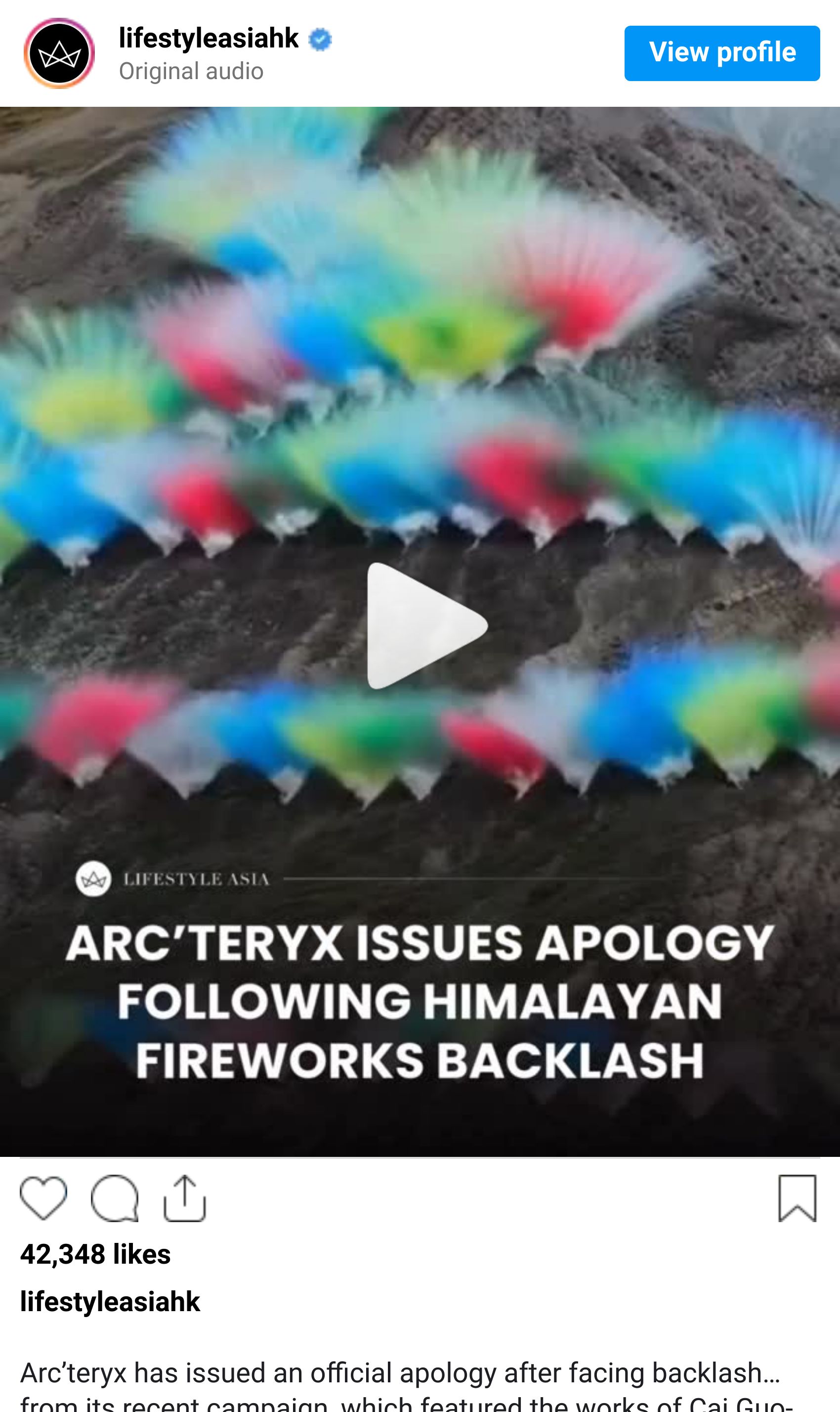
The third is the cultural detonation. In September 2025, Arc'teryx collaborated with Chinese artist Cai Guo-qiang on a 2,500-metre-long pyrotechnic dragon in the foothills of the Tibetan Himalayas, meant to highlight the brand's connection to nature. The boycotts followed. Arc'teryx issued statements in English and Chinese worded differently, attributing blame in different places, before eventually conceding the display was out of line. A brand whose entire positioning is built on respecting the mountain set off fireworks on a sacred one. The collaboration didn't fail to connect. It revealed that Arc'teryx never understood what it was supposed to be representing in the first place.
Why the move stopped working
A collaboration is a credit transfer. You borrow against the cultural capital the other party has built, and it only works if they actually have any to lend.
What does Crocs have to offer Krispy Kreme that Krispy Kreme doesn't already have? What does Krispy Kreme give Crocs that Crocs doesn't have? They're both novelty brands, both already in on the joke. The collaboration is two empty wallets meeting at a bar and pretending to pick up the check. No amount of saturation would have killed the Travis Scott deal if the credit transfer had been real — the format isn't exhausted, the currency is.
@krispykremeuki Are you ready to walk like you’re the hottest thing on the menu? @crocs x Krispy Kreme 05.08.25
The five-year question
Writing for Creative Boom, Matt Herbert, co-founder of Tracksuit, framed the question that separates a strategic partnership from marketing theatre: if this partnership had never happened, would your brand be meaningfully weaker five years from now?
Almost no recent collaboration passes it. Travis Scott x McDonald's does — it's in business school case studies now, and it marks the moment celebrity meal deals came back as a category. McDonald's is still drawing on the cultural permission it bought in 2020. The Swatch x Omega Moonswatch passes it too: a £200 watch that made Omega feel accessible without making it feel cheap, and drove people into stores who'd never considered either brand before.
The mistake is treating "we got the attention" as a substitute for "we built the brand." Legacy brands are losing relevance with the audiences they need, and collaborations are the cheapest way to look like they haven't. Cheez-It needs to look like it understands culture. Crocs needs to look like it's still in on the joke six years into being in on the joke. None of them have the time, conviction, or organisational courage to build that themselves, so they rent it for a quarter.
The next time someone suggests a partnership, the question isn't who can we collaborate with. It's what do we have that's worth lending. If the answer is a logo and a budget, the collaboration fails — not at launch, but five years on, when nobody remembers it happened.
Somewhere in a warehouse right now there is a candle that smells like a moor nobody has ever stood on. That's what happens when the move outlives the reason for making it.
