

The Gods of Food
Noma was the restaurant that made Copenhagen a destination, that convinced the food world that Nordic wilderness — fermented this, foraged that, pine cones cleaned by unpaid interns working sixteen-hour days — could carry the same weight as a Burgundy cellar or a Japanese knife tradition. The mythology was total and carefully tended: Redzepi on the 2013 cover of Time magazine under the headline The Gods of Food, five rankings as the best restaurant in the world, three Michelin stars, a Danish knighthood from Queen Margrethe II. Each credential raised the stakes of what Noma was promising — not just a restaurant anymore, but proof that fine dining could be morally evolved, aware of its own contradictions, actively fixing them. The higher the accolades climbed, the more fragile the whole construction became.
And alongside it all, a nonprofit Redzepi had founded called MAD, its mission, in his own words, would you believe, "to help chefs and food professionals lead the change that their industry needs." That promise was built on something unsustainable. Nobody inside was willing to admit it.
What the Guests Couldn't See
When the New York Times published its investigation on March 7th, the portrait that emerged was of a man who would crouch under kitchen counters while customers dined in the next room, jabbing his staff in the legs with his fingers or whatever utensil happened to be nearby — crouching so the guests wouldn't see. Thirty-five former employees described eight years of punches to the face, bodies slammed against walls, threats to blacklist people from restaurants worldwide, threats to have families deported. One former employee wrote of panic attacks in the night, of leaving the career she'd loved because the trauma and the certainty that nothing would ever change had finally become heavier than the work — and of watching others stay anyway, because they needed the paycheck, or the reference, or both. Jason Ignacio White, former head of Noma's fermentation lab, described watching Redzepi drop his own child to choke a team member over a strawberry. Alessia, now cooking in London, remembered standing in the kitchen through all of it.
Going to work felt like going to war. You had to force yourself to be strong, to show no fear. She left.
One chef, when the story broke, offered something that sits differently from the rest of the testimony. He just went down the line and punched us in the chest. It was hell, but I learned so much that I can't say I regret it. The suffering and the gratitude, offered up together, inseparable — as though this is simply how excellence gets made. This is what the mythology produced: not just abuse, but a culture so normalized that even its victims couldn't fully name what was wrong.
The Logic That Made It Normal
To understand how the mythology held for so long, you have to understand the system that made the abuse look inevitable rather than abusive — that made it look, in fact, like training. The brigade system, developed by French chef Georges Escoffier at the turn of the twentieth century and modeled on his military experience, didn't just create the conditions for this. It provided the justification. You weren't being abused. You were being forged.
The entire cultural ecosystem reinforced it. Marco Pierre White titled his memoir The Devil in the Kitchen and wrote of his chefs as "pain junkies." Gordon Ramsay yells at people on television and we've always found it entertaining. The Bear won awards for a kitchen where cruelty is the weather in which greatness breathes. Each of these — the memoir, the reality show, the prestige drama — told the same story: this is what it takes. When Noma sat at the top of that system, it became the proof that the logic worked. The restaurant didn't just participate in the mythology. It was the mythology. The industry had already decided that what was happening inside Noma was necessary. All the brand had to do was maintain the silence.
Redzepi had been inside this logic his whole career, and had also, for years, performed the work of dismantling it. Filmed screaming at cooks in the 2008 documentary Noma at Boiling Point. The 2015 essay confessing to being a "beast" who bullied subordinates, framed as the beginning of a slow evolution. Speeches about a new path forward. A nonprofit built on the premise that he understood what needed to change. Asked in 2022 by The Times of London whether he'd ever hit anyone, he said he had "probably bumped into people."

Worthy of an Oscar
A brand with three Michelin stars, twenty years of global coverage, sponsors like American Express, and a chef knighted by the Danish crown — and this is the best they could come up with.
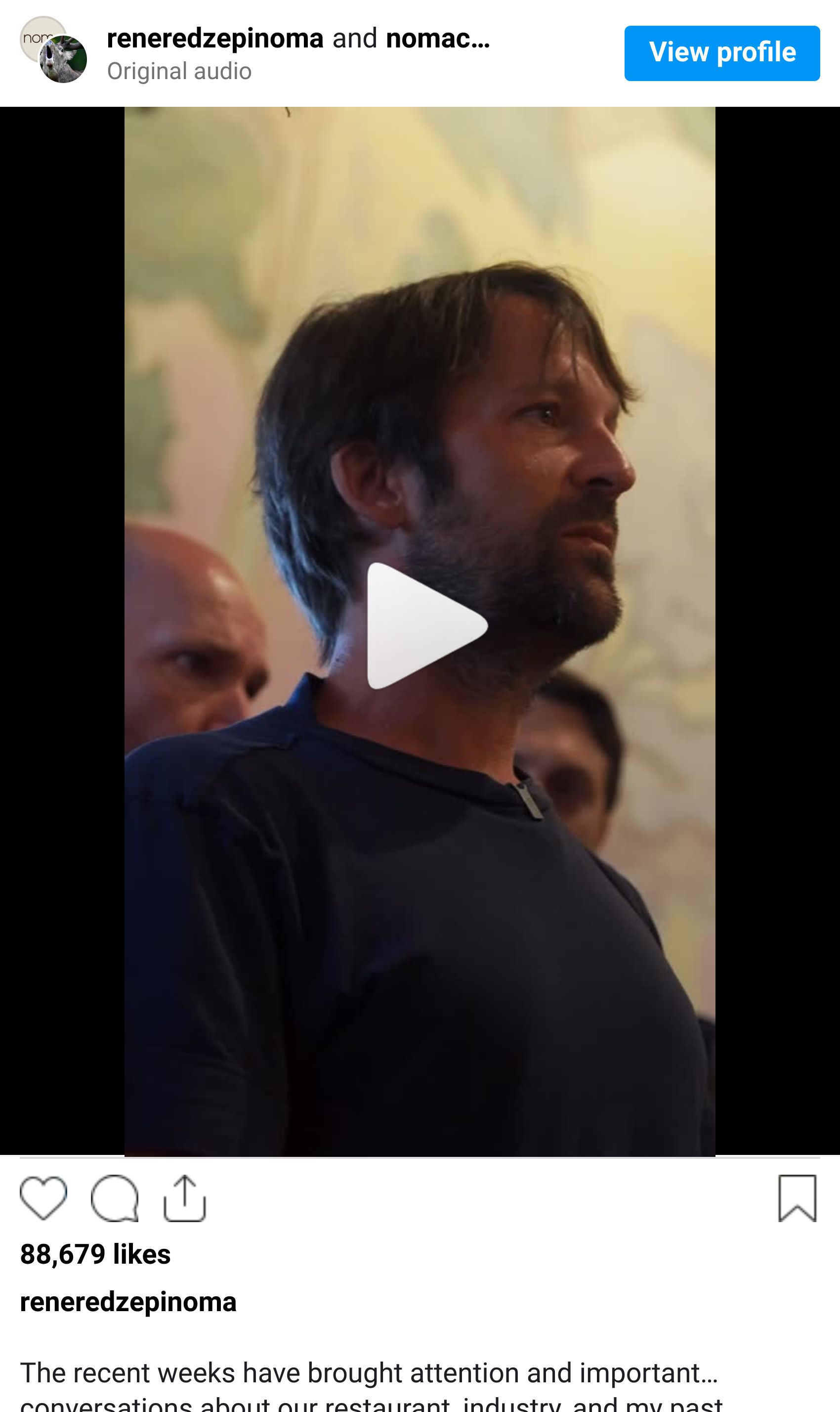
The Instagram statement arrived on March 12th, with comments blocked. That alone says everything. A brand talking about "important conversations" while actively preventing those conversations from happening on its own channel.
Read it slowly, because every paragraph does something different and none of them are what they appear. It opens with "the recent weeks have brought attention" — not "I abused my staff." The attention arrived. As if it were the weather. Then "I have worked to be a better leader" — past perfect, work already done, case closed — followed by "an apology is not enough," which sounds like humility but functions as a shield. If he himself says an apology isn't enough, nobody can accuse him of his apology not being enough. Then the pivot: "The Noma team today is the strongest and most inspiring it has ever been." Thirty-five people had just described eight years of trauma, and the institutional response was to celebrate the institution that allowed it. And at the end, the sentence that summarises the entire exercise: "Noma has always been bigger than any one person." Which translates as: the problem was one person, that person is leaving, move along.
So amongst all this, it begs the question. Where was the PR team? Because what came out doesn't have the signature of an agency with experience managing a crisis of this magnitude. A brand of this level, with this global exposure, should have had protocols. The possibility that something like this could surface — not because the abuse was necessarily predictable, but because brands built on mythologies this fragile always, at some point, break. Instead what emerged was reactive, improvised, fatally miscalibrated. Blocking comments at the moment your victims are speaking publicly isn't crisis management. It's evidence that you don't have one.
Nobody was convinced. White called it "magical PR attempts to hide the truth" — magical the way a conjuring trick is magical, something designed to make the real thing disappear. American Express, Resy and Blackbird had already gone. The pop-up kept going, the $1,500 plates kept going out, and somewhere in Silver Lake, the people Redzepi had punched in the ribs were drafting demand letters while he filmed himself crying for his staff.
What Redzepi — and whoever was advising him — couldn't see, or wouldn't, is that the crisis was never about individual incidents. It was about a promise that required the abuse to sustain itself. The only way through would have required admitting that everything he'd built was unsustainable — a real crisis team, spokespeople other than himself, comments open even when it hurt. Instead he tried to preserve the mythology. And in doing so, finished destroying it.
The Gap
The particular exhaustion of Noma's situation is that Redzepi understood this better than most. He wrote about it, spoke about it, built a nonprofit around it. The gap between the man on the MAD stage and the man crouching under a counter so guests wouldn't see — that gap isn't something a carefully worded caption can reach.
Forty people stood in a Copenhagen winter, in short sleeves and aprons, and said nothing. Filed back inside. The kitchen returned to work, the mythology grew, the reservations stretched two years out, and no one mentioned the episode again.
Until one person started writing it down. Whether that turns out to be enough — for Alessia, for the woman who left the career she loved, for the people still waiting on a settlement — is a question the Instagram statement, comments blocked, never thought to ask.
