

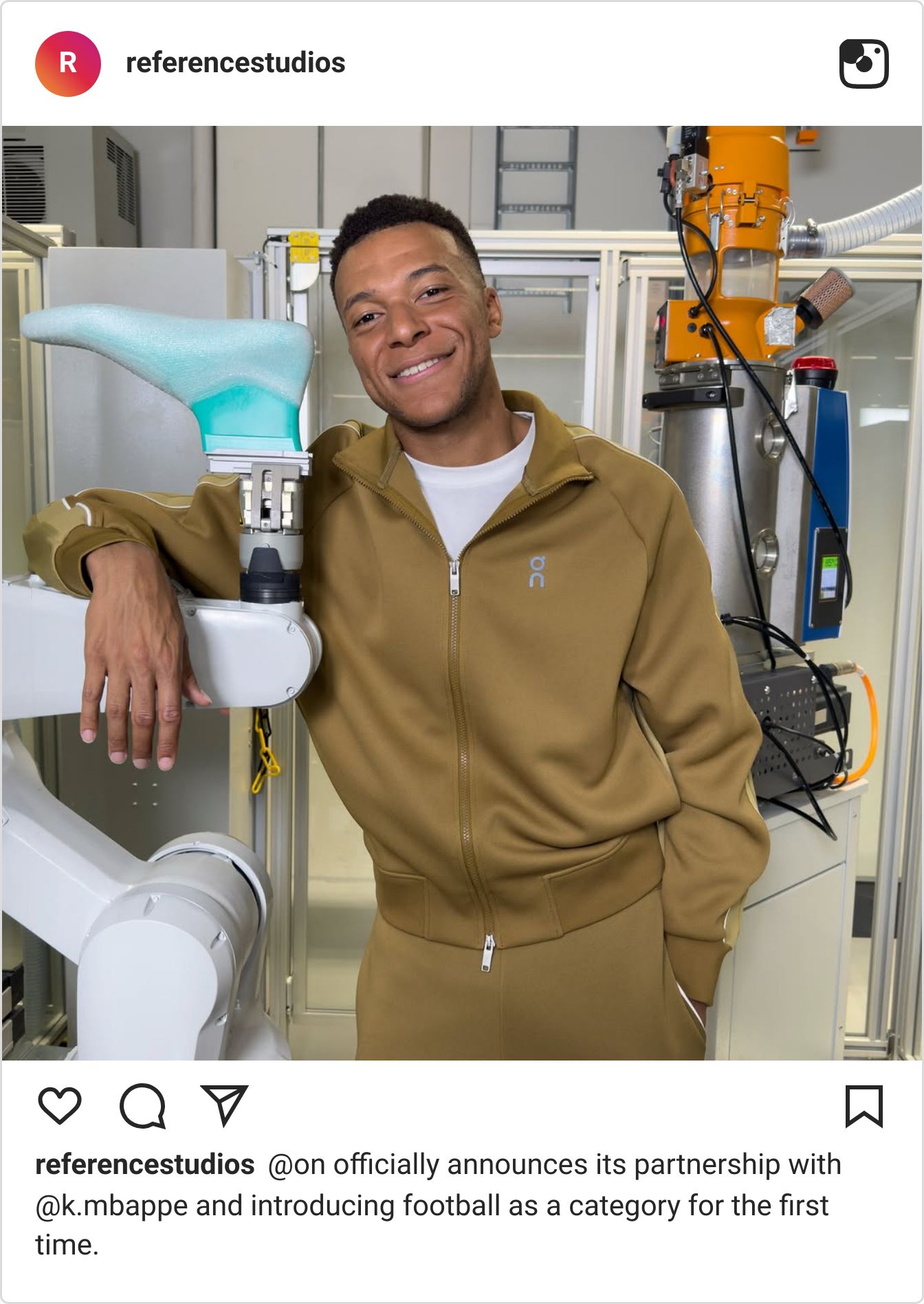
Kylian Mbappé’s contract with Nike expired on 31 July. Seven weeks later he signed with a company that has never sold a football boot.
That’s an odd sentence to write about the World Cup’s all-time top scorer. Nike had sponsored him since 2006, when he was a boy in Bondy, and he wore Mercurials through every stage of his career — Monaco, PSG, Real Madrid, a World Cup win at 19 — and through this summer’s tournament, which he finished on 22 goals, one ahead of Lionel Messi. Then he left for On, a 16-year-old Swiss running brand whose first boots won’t exist until 2027.
What On had that Nike didn’t was something to give away: a piece of itself. The deal includes cash and equity, the same structure On used to sign Roger Federer seven years ago. The reason it works traces back to an afternoon in Switzerland and a length of garden hose.
The Prototype Nike Passed On
Olivier Bernhard was a Nike-sponsored athlete when he took his idea to Nike. He was a former Ironman champion and a three-time duathlon world champion, and he had glued sections of garden hose to the sole of a running shoe, chasing a soft landing and a hard push-off. Nike passed. (In fairness, Bernhard later admitted the prototype was hideous, and that in Nike’s position he might have laughed it out of the room too.)
He showed it to two friends in Zurich, David Allemann and Caspar Coppetti, who thought it looked terrible until they ran in it. The three founded On in 2010, and the hose became CloudTec, the hollow pods still visible on the bottom of every On shoe.

The selling was just as unglamorous. While Nike and Adidas bought reach through stadiums, billboards and the Olympics, On went shop by shop through running specialty stores, the kind where staff watch you jog across the floor before they hand you a box. The founders won those owners over one shop at a time. By 2019 On held 40 percent of the Swiss running shoe market.
It’s about the least scalable marketing plan imaginable, which was rather the point. A running-shop owner’s whole business is being right about shoes, so when one of them recommends you, the customer isn’t hearing an ad; they’re hearing the one opinion in the room they’ve already decided to trust. That recommendation also keeps working after you stop paying for it, which no billboard has ever managed. Most brands buy attention first and hope trust follows. On earned the trust of the people customers already listened to, and let the attention come from there.
An Owner, Not a Face
Federer split from Nike in 2018 after more than two decades. Nike kept his RF logo, at least until its stock of Federer apparel sold out, and he signed with Uniqlo for clothing, reportedly for $300 million over ten years. It was a fee, which is how nearly every athlete deal works: the brand rents the face, the athlete cashes the cheque.
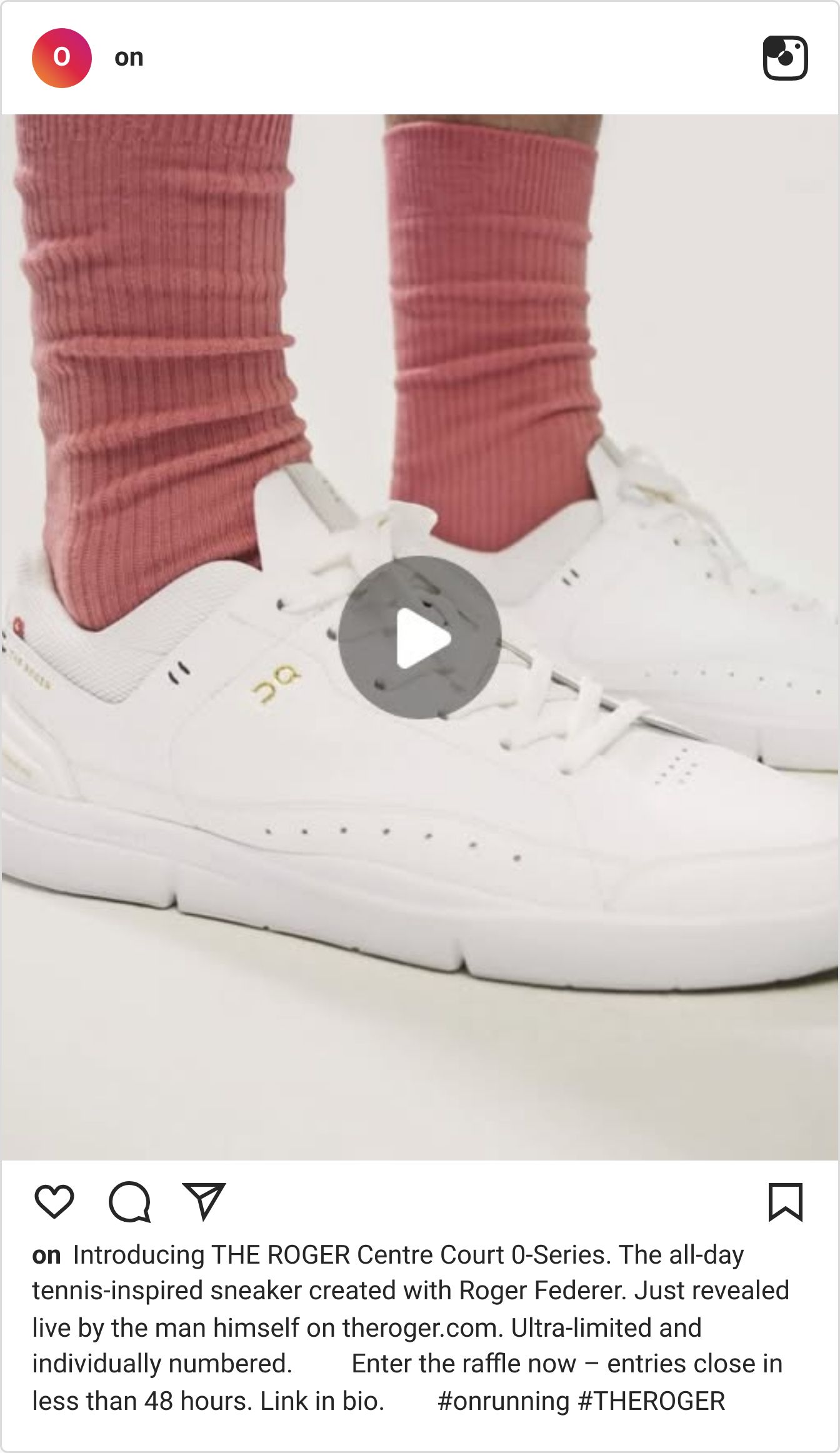
Footwear went differently. His wife Mirka had started wearing On, and he reached out to the founders himself. In late 2019 he joined as a partner and an investor, for a stake widely reported at around 3 percent, and then did something faces don’t usually do: he got involved in the product. He pushed On into tennis, a sport it had no history in. The Roger Centre Court went on sale on 6 July 2020, the anniversary of his first Wimbledon title, as a $250 sneaker with a numbered first run of 1,000 pairs. A performance court shoe, The Roger Pro, followed.
On’s net sales went from CHF 267 million in 2019 to CHF 3.01 billion in 2025. The running boom did much of that work, and On was doubling sales before Federer arrived. What matters is what the structure did to him. A fee rewards an athlete for turning up to the shoot. A stake rewards them when the brand does well, so they start behaving like someone who needs it to, suggesting products and talking about it when nobody is paying them to.
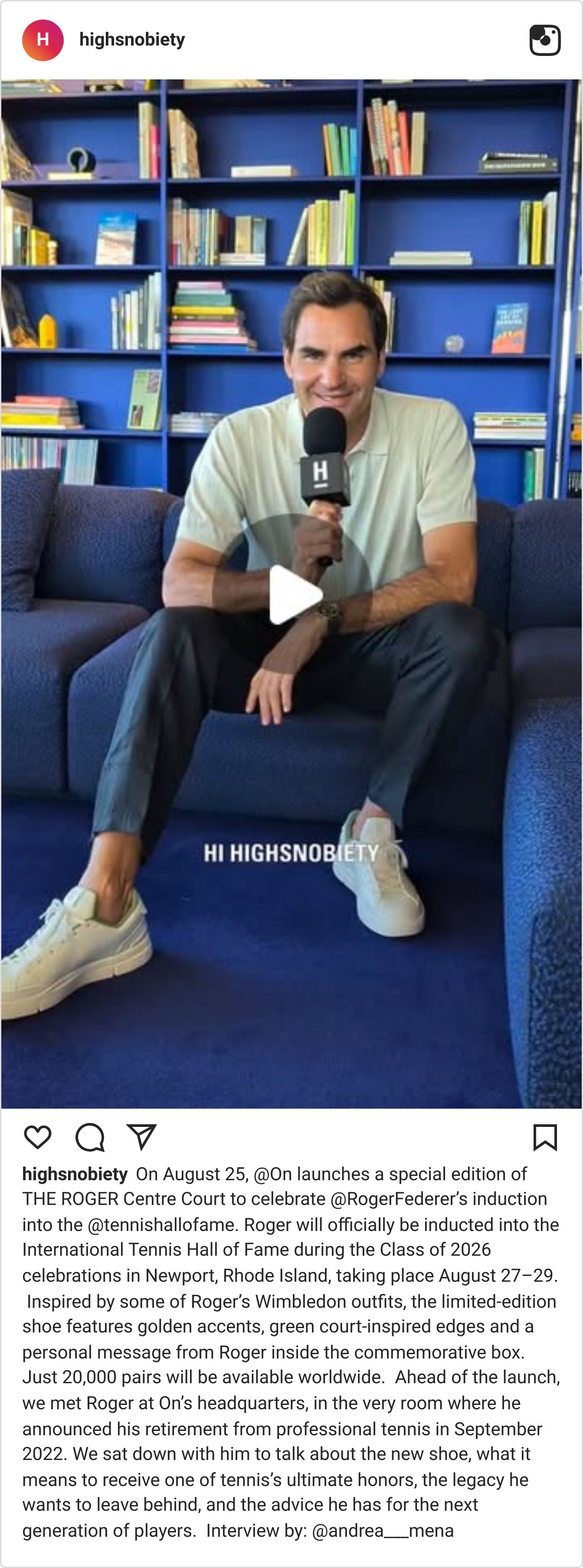
It paid off on both sides. In August 2025 Forbes declared Federer a billionaire, partly on the strength of his On stake. “Roger was the accelerator,” Marc Maurer, On’s co-CEO at the time, told the magazine. This August, On released a Hall of Fame edition of The Roger, limited to 20,000 pairs, and seven years in, nobody is wondering whether Federer actually wears the shoes.
Most companies can’t hand out equity like party favours, but the idea scales down further than you’d think. The candle brand that develops a scent with its most loyal customer and puts her name on the label, or the agency that gives a referral partner a cut of every account they bring in, is paying its advocates in ownership rather than appearance fees. People talk differently about something that’s partly theirs.
The Sole Is the Logo
Look at an On shoe from across a room and you know what it is, which is more than most running brands can say. The hollow pods that started life as garden hose are the technology and the branding at once; nobody needs a swoosh to recognise CloudTec. That is a large part of why the shoes travelled from running tracks to airport lounges.
The fashion world found On before On went looking for it. Loewe has collaborated with the brand since 2022, including a LightSpray version of the Cloudmonster. Zendaya was already wearing On’s Cloudtilt off-duty before she signed anything, and she wore On on the Challengers press tour, for a film costumed by Jonathan Anderson, Loewe’s creative director at the time. In 2024 she signed a multi-year partnership, and this spring she released her first co-created collection with stylist Law Roach, launched with a Spike Jonze film called “Shape of Dreams”.
Mirka Federer was a customer before Roger was a partner, and Zendaya was a customer before she was a campaign. On tends to sign people who already wear the product, which is why its famous faces rarely look like they’re reading from a script — and why a running brand has been able to stretch into clothing, now about 7 percent of sales, without the runners feeling it had stopped being theirs.
Nike Cut the Stores. On Cut the Volume.
If you want to see the opposite strategy, Nike has kindly run it for you. Under CEO John Donahoe, it cut as many as half its wholesale partners to push shoppers toward Nike.com and its own stores. The shelf space it walked away from didn’t stay empty, and a good share of it went to On and Hoka. Nike, in other words, cleared room on the shelf for its competitors.
It also kept making shoes at roughly the same pace, so when demand cooled the extra pairs went on sale and took Nike’s margins with them. Elliott Hill, the Nike veteran who replaced Donahoe in 2024, told analysts the company had alienated its retail partners. “We lost our obsession with sport,” he said.
On made the opposite call: it kept the stores and cut the volume. Most footwear brands ship whatever a retailer orders and help fund the markdowns when it doesn’t sell, which is how a season ends in a sale bin. On now sends retailers less than they ask for.
The second quarter of 2026 shows the bill. Wholesale growth fell from 25.1 percent in the first quarter to 12.7 percent at constant currency, and some of that wasn’t by choice: management admitted its everyday running shoes sold more slowly than expected in American stores. Direct sales rose 34.3 percent and gross margin reached 65.4 percent, up almost four points despite higher US tariffs. Investors had bought On for growth, though, and on 11 August the shares fell by about a fifth. The company that refused to discount its shoes had let the market discount its stock instead.
For a smaller business the same trap usually arrives as an email: 20 percent off, this weekend only, sent most weekends. Every discount teaches customers something, and what it mostly teaches them is to wait for the next one. On’s version of discipline cost it a fifth of its market value in a day, which is a useful reminder that holding your price is a decision you have to be able to afford. The brands that can afford it are the ones customers never think of as being on sale.
Owning the Machine
Outside Busan, 32 robots spray thermoplastic filament onto moulds and build one-piece shoe uppers in minutes, with no glue involved. On calls the process LightSpray and says it compresses roughly 200 steps, normally spread across several factories, into a single automated system. The site opened in February, and On says it has increased LightSpray capacity thirtyfold.
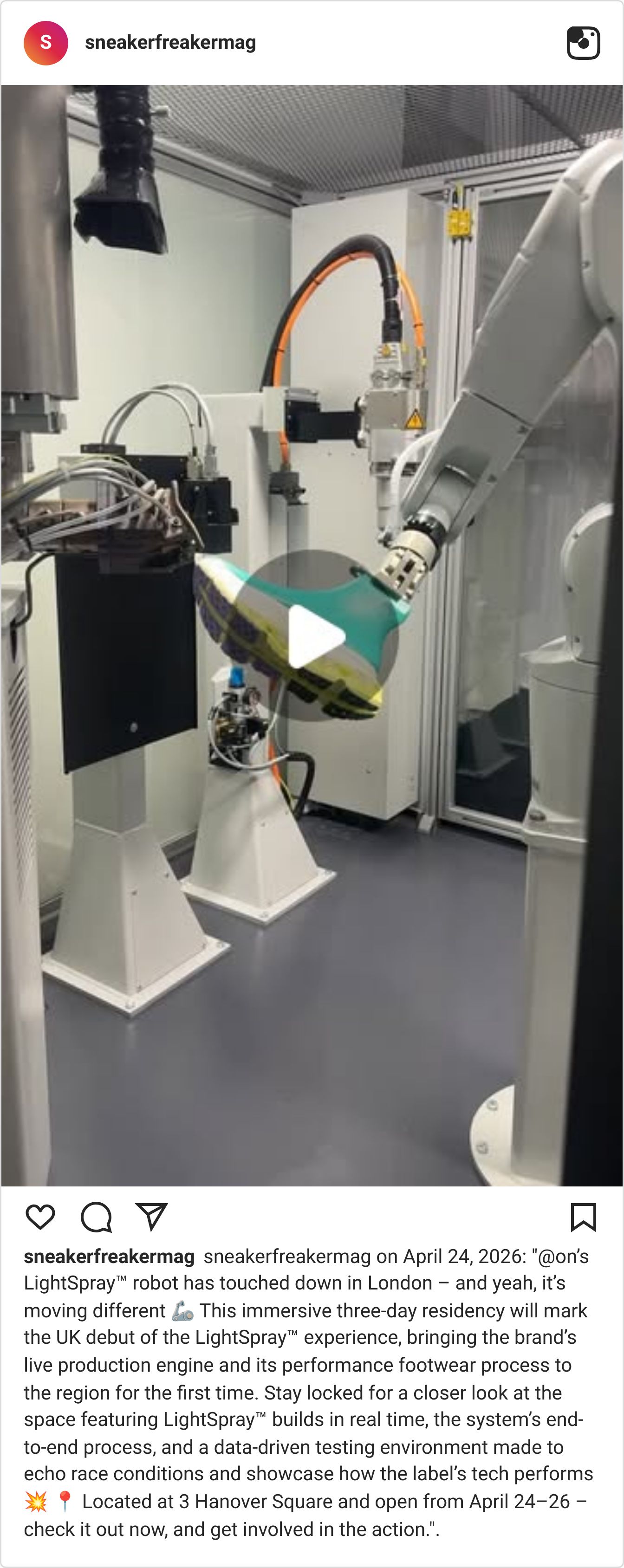
Thirtyfold still means about 1,000 pairs a day, which won’t trouble the accountants. On makes 90 percent of its shoes with partners in Vietnam and the rest in Indonesia, and a factory this size doesn’t move that split. Further plants are planned for the Americas and Europe, closer to customers and further from US tariffs. For now, Busan is a proof of concept and a hedge rather than a supply chain.
The robots look like a technology story, but they’re really a pricing story. Whoever controls how many shoes exist controls whether they ever get marked down, and On is slowly bringing that control in-house.
Buying Into a Boot That Doesn’t Exist
Thierry Henry has been On’s director of football since 2025, and he reportedly helped persuade Mbappé to join. The first boots are due in 2027, built on LightSpray, with Mbappé working directly with the product teams until then. “What attracted me to On was the chance to build something entirely new,” he said, which is not a sentence athletes usually say about a boot deal.
Federer joined a small running brand and pulled it into tennis. Mbappé is joining a listed company worth around $9 billion and being asked to do the same thing in the most contested category in sportswear. Nike has already lost Lamine Yamal to Adidas this year, but losing Mbappé to a company with no boot on the market is a stranger kind of loss.
None of this guarantees On wins football. Its shares are down about 40 percent on the year, its American wholesale business is wobbling, and Nike and Adidas have decades of heritage and most of the major clubs. Not everyone can copy it, either. On could afford a slower year because it ended 2025 with more than CHF 1 billion in cash and a stock-market listing behind it. Most founders don’t have that cushion, and every stake handed to an advocate is a slice of the company that doesn’t come back. What On has done, at every step, is keep control of the things that decide what a premium brand is worth: who vouches for it, who owns a piece of it, how many pairs exist and what they cost.
On didn’t have a boot to offer Mbappé, so it offered what it has always offered its athletes: a share of whatever happens next. Sixteen years ago, a Nike athlete took an idea to Nike, was turned away, and built a company around it. This September, Nike’s biggest football star walked out the same door, and that company made sure he’d own part of it.
