

At Loewe's Spring/Summer 2025 womenswear show in Paris, Jonathan Anderson took his final bow in tears. The audience stood, the applause ran long, and he wiped his eyes and walked off the runway. Three months later, he confirmed it: he was leaving for Dior after eleven years.
That handed Loewe a problem most companies never have to face so publicly. Anderson had grown the house from a quiet leather label into one of the most culturally influential names in fashion — revenues roughly quadrupled under his watch, by industry estimates — and he'd done it by making himself more or less synonymous with the brand. Now Loewe had to find out, on a schedule, in front of everyone, whether any of what he built was actually theirs to keep.
This is the question most companies only ever face in private, and usually too late. The creative director who built the agency's best decade moves to a competitor. The founder-CEO steps back and the product quietly loses its edge. The head of strategy leaves and the clients start to drift. We have built a whole era of brand-building on making the visionary and the brand inseparable — and mostly skipped asking what happens the day they walk out. Loewe had to answer it out loud, with the revenue reported quarterly. What it found is worth paying attention to.
Anderson is useful precisely because he was never a founder. He was a salaried creative director at an LVMH-owned house, with a reputation portable enough to take straight to Dior. Every incentive in front of him said keep the vision personal. He did the opposite. And the question worth answering isn't only what he built — it's why he built it to stay when almost nobody in his position does.
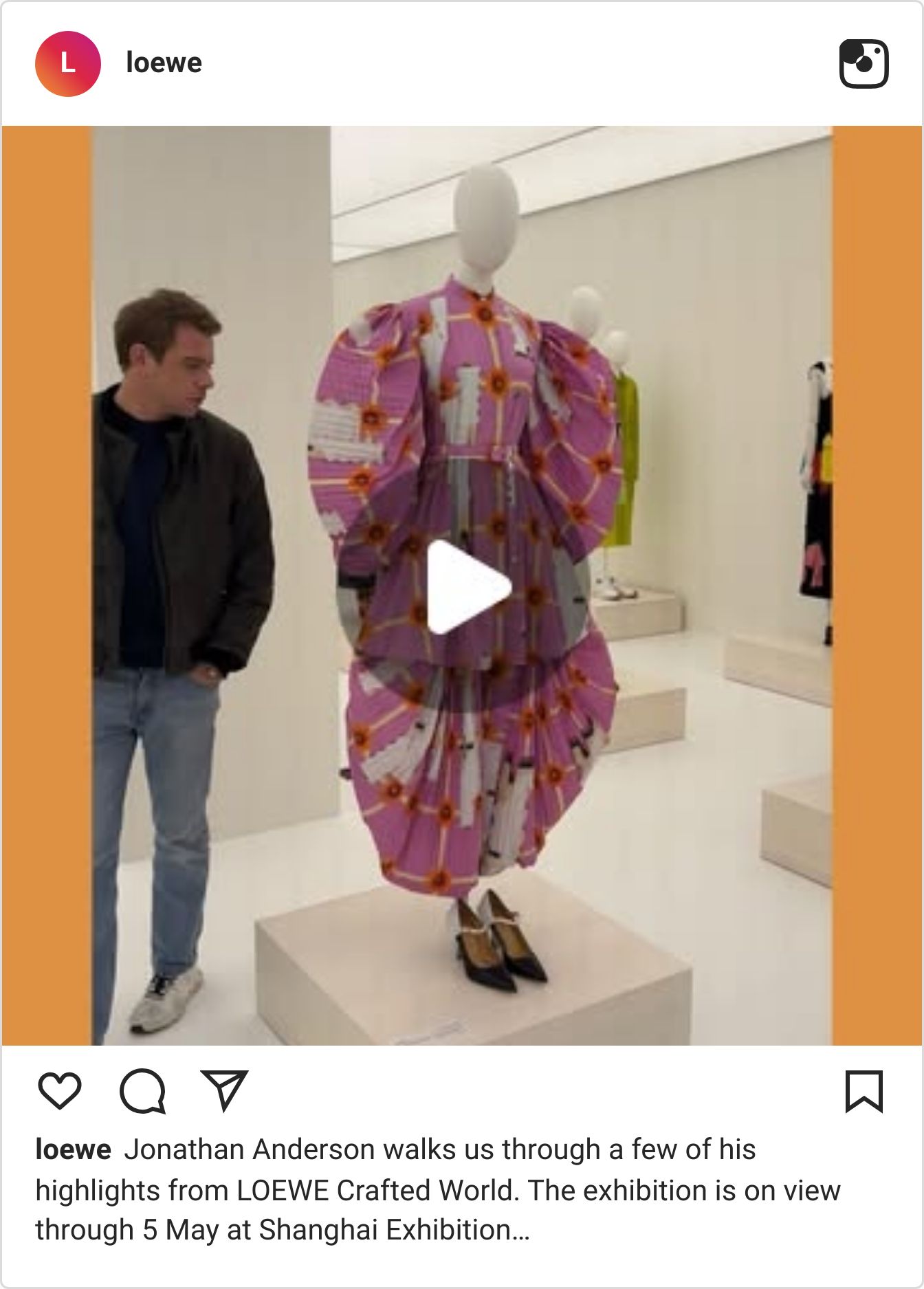
@loewe A new book, ‘CRAFTED WORLD: Jonathan Anderson’s LOEWE’, explores the transformation of the House under Jonathan’s vision over the past ten... See more
His name was nowhere on it
The Loewe Foundation Craft Prize is the clearest tell. Anderson launched it in 2016 — an annual award for makers worldwide, run by the Loewe Foundation and named for the house — and his own name appears nowhere on it. He told Dezeen the intent was institutional from the start: the work was there in the craft world, he said, but "the platform was not there." He wanted to build the platform. Not name it after himself. Not carry it to the next job. Build it for the house and leave it there.
Most visionaries do the opposite, and it's rational that they do. The award named after you, the newsletter with your face on it, the following that moves when you move — these are the career assets that get you the next role. Anderson had every incentive to build the same way and built differently: the Craft Prize, the art collaborations, the codified design language, the archive — all of it structured to belong to Loewe rather than to him. Over eleven years, those codes stopped being his signature and became the institution's. In 2022 he told Vogue: "Craft, art, design — our creative output has never been more important. It reminds us that we are human somehow." The possessive was the house's. Not his.
This distinction — between building for the institution and building for yourself — is the one most brand-builders never make on purpose, because the incentives point the other way. The ECD whose best decade of work lives in a personal reel — whose name is why the best briefs come in, whose taste is the thing clients are actually paying for — is doing the logical thing. The reel travels. When they move to a competitor or go independent, it goes with them, and the agency finds out what it actually owned. The founder who is the product, the strategist whose client relationships are all personal rapport: each is making the same rational calculation. When they leave, everything they built goes with them, because it was never really the company's to keep.
What happens when it stays personal
Fashion runs this experiment in public. The same three years that tested Loewe tested three other houses that had bet everything on one person, and the results were consistent.
Alessandro Michele built Gucci into a cultural phenomenon and left in 2022 with revenue nearly tripled; under his successor, sales fell 13% on average through Q3 2024 and 25% in the first quarter of 2025. Sarah Burton gave Alexander McQueen its most commercially stable chapter and left in 2023; by 2025 Kering had announced a full restructuring after what it called years of steep decline. Alber Elbaz spent fourteen years reviving Lanvin and was fired in 2015; his successors rotated so fast the house never recovered a coherent identity, and it is still paying for that today.
The pattern is the same each time. The company loses the person and its identity in the same week, because the two were never separated. Audiences that came for the vision have no reason to stay once it's gone, because the vision was never the company's to begin with. It was on loan — and loans come due.
The codes outlasted the people who built them
When Anderson left for Dior, he didn't go alone. He took his creative inner circle with him. His successors, Jack McCollough and Lazaro Hernandez, had to build a new team from scratch — new collaborators, new ambassadors, none of the relationships Anderson had spent a decade forming. The vision had to survive not just without him, but without the people he'd worked with most closely.
It did. In their show notes for the debut collection, shown in Paris in October 2025, McCollough and Hernandez described what they found when they arrived: "To enter Loewe is to take on codes shaped over 180 years of history, defined above all by an enduring commitment to craft and its Spanish identity. Our task is to carry this spirit forward, interpreting it through our own distinct lens." They weren't describing what Anderson had briefed them in a handover. They were describing what was already in the building — in the Foundation, the Craft Prize, the product design language, the archive — waiting to be picked up by whoever came next.
That's the mechanism, and it's the part most succession plans miss. The vision survived because it had been written into the institution rather than held in one man's head. His talent left with him. His contribution didn't, because he'd spent eleven years making sure it belonged somewhere other than himself.
@nssmagazine Jonathan Anderson has lowkey built his own fashion family 👀 In recent months, Drew Starkey, Taylor Russell, Josh O’Connor and more have be... See more
The job was to become unnecessary
Every instinct says the other way: make yourself indispensable, because the more they need you the safer you feel. The personal brand, the irreplaceable relationship, the vision only you can execute — these feel like security. They're actually the opposite. The day you leave, or are asked to leave, everything you built leaves with you. The company starts again. The clients drift. The culture collapses back to zero.
Anderson did the harder thing. He spent eleven years making Loewe not need him — turning what is usually a loan into something the house owned outright. He kept the personal reputation too; it took him to Dior. The trade-off most people accept turns out not to exist.
Everyone is replaceable is the comforting line. The rarer and more useful truth is this: the people worth keeping are the ones who make themselves replaceable on purpose, and leave the building standing when they go.
