

Rory McIlroy's heart rate hit 135 beats per minute standing on the 18th tee at Augusta on Sunday, and his body immediately showed why that number mattered by sending his drive straight into the trees. Tournament on the line, back-to-back Masters glory hanging in the balance, eleven years of major near-misses piling up in the background. The approach came out at 129 BPM. The winning putt dropped at 105. Then he collapsed onto the green and his heart rate spiked to 150 during the celebration — higher than anything his body registered during actual competitive pressure all week.
Within hours, WHOOP CEO Will Ahmed posted the full biometric breakdown to X. By Sunday evening, that readout was bouncing through sportsnut WhatsApp groups and Reddit threads getting deep around the performance. Yes we know golf is not the sport that requires the most athletically gifted athletes to play. But there is something special around that extra layer that brings you closer to the performance. I for sure know, if I am on the 18th hole and in the trees my heart rate would be lucky not to put me in hospital.
Its good to know he is human with his performance figure slipping to just seven per cent on Monday, suggesting that he celebrated until the early hours of the next morning. And well deserved.

Skin in the game
McIlroy first invested in WHOOP in 2020 at a $1.2 billion valuation, which puts his relationship with the brand in a structurally different category from an endorsement deal with a sleeve fee and a social post obligation. WHOOP closed a $575 million Series G on March 31 of this year at a $10.1 billion valuation, and McIlroy participated in that round alongside LeBron James, Cristiano Ronaldo, Reggie Miller and Niall Horan.
When Ronaldo posts his recovery score on Instagram, which he does regularly, he's promoting something he owns a piece of — which lands differently than a disclosure buried in a caption. Ahmed made the same bet on himself, sharing his own biometric data publicly often enough that the CEO has become a walking proof point for the product's accuracy. Whether that's unusually committed brand strategy or just what happens when a founder genuinely believes what he's selling, the effect is identical: the entire ecosystem runs on people whose money and bodies are both in it. The enthusiasm is very hard to fake when the product being accurate is, for the people promoting it, a financial matter.
What they chose not to build
To understand what WHOOP actually built, it helps to look at what they chose not to build. The health wearable category in 2026 is a study in how many different bets you can place on the same underlying consumer anxiety: not knowing enough about your own body.
Garmin has the athletes who were already athletes before anyone told them to track anything. The Fenix sits on the wrist of everyone who's ever trained for something serious enough that their running shoes cost more than their television. It calculates ground contact balance and vertical oscillation ratio, loads maps on board, and cares nothing whatsoever about your recovery or your feelings.
Apple went the opposite direction, putting a health wearable on 100 million wrists by making it the logical next step after the iPhone. The Watch counts steps, reminds you to breathe, and includes fall detection that has genuinely helped people's grandmothers — which is not nothing, but is not a performance brand.
Then there's Oura, which made almost the opposite bet to WHOOP on every dimension that mattered: a ring instead of a band, sleep-focused rather than strain-focused, aesthetically led, overwhelmingly female in its growth demographic, and wellness-positioned rather than performance-positioned. Jennifer Aniston wears one. That female demographic isn't incidental to Oura's trajectory — women's health, particularly menstrual cycle tracking and fertility insights, has become the growth engine for the wearable category in ways that performance metrics for athletes never were. Oura sold more than half of its 5.5 million lifetime rings in 2025 alone, which tells you something about the size of the consumer who wants biometric data delivered in something that doesn't look like a commitment.
Oura sits at an $11 billion valuation. WHOOP sits at $10.1 billion. Two companies, opposite positioning bets on nearly every dimension — male-dominated athlete performance versus female-focused wellness and cycle tracking — essentially the same outcome. That's the most clarifying fact about either of them. There's more than one way to win in biometric data. The requirement isn't which direction you choose but whether you go far enough in it.
WHOOP's direction was to strip nearly everything out. No screen. No step count. No casual use case. The hardware is free; the membership, where the data and coaching live, runs as a monthly subscription, and without it the device goes dark. That last detail matters more than it sounds. WHOOP's users aren't customers who bought something and moved on. They're members in a continuous contractual relationship with a platform that knows their body over time, which is why the data it generates reads as a story rather than a statistic. Eight times a day, on average, members open the app — nearly three times higher than competing screenless wearables. They're not checking a number. They're understanding what that number means for today, in the context of yesterday, and the six months before that. Every design decision WHOOP made excludes someone who might otherwise have been a customer, and that exclusion is the point. A screenless band on the 18th fairway at Augusta doesn't look like something you bought because a lifestyle quiz recommended it.
The second broadcast
What WHOOP captured at Augusta — and what went viral within hours of Rory raising the trophy — was something sports broadcasts have spent decades manufacturing approximations of without quite getting there. McIlroy's recovery scores across the week ran 89% on Thursday, 79% on Friday, 94% on Saturday, 87% on Sunday, with a resting heart rate sitting between 47 and 49 BPM throughout. His overall recovery score had increased 23% from December 2025 to March 2026 — someone had built his entire training periodisation around Augusta, and the data captured the arc of it.
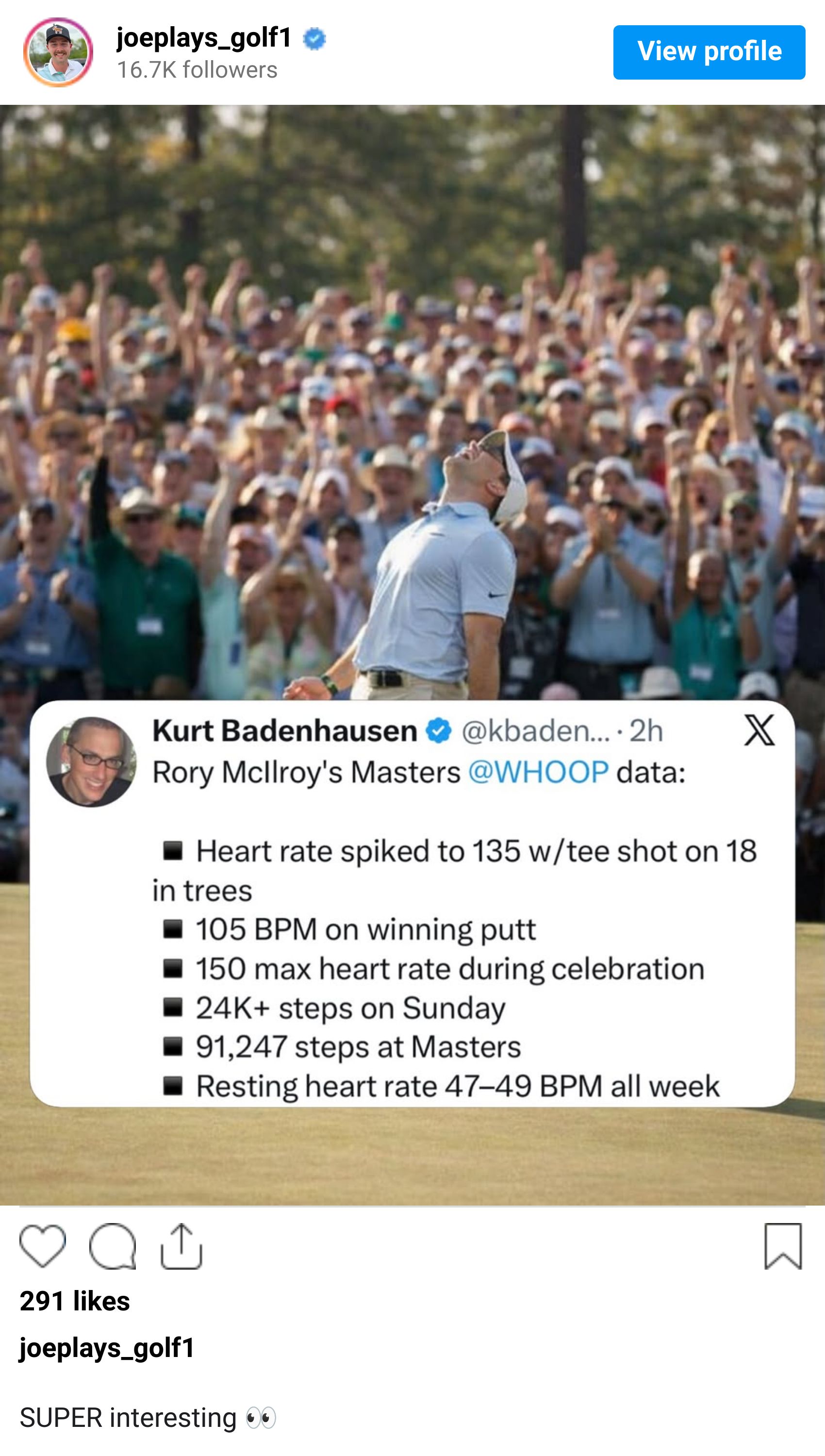
The 135 BPM on the 18th tee tells you something the broadcast never could: the machine registered exactly how much the moment cost him before he'd even swung the club. The drop to 105 on the winning putt reveals what eleven years of near-misses builds in a person. And heart rate is the right data for this to work. Everyone has felt 135 BPM — on a treadmill, in a difficult meeting, at the top of something high. You don't need to be a physiologist to read Rory's biometrics and understand what they mean about the person standing over that putt. That legibility is what made Sunday's data shareable in ways that most sports biometric data never manages to be. Strava segments go viral occasionally. F1 telemetry is available and mostly scrolled past. What crossed the threshold on Sunday was a genuinely legible data set attached to a genuinely consequential moment, made trustworthy by the fact that the man whose data it was had real financial skin in the accuracy of the instrument collecting it.
Sports brands have been chasing that shareability for a long time. Run clubs work partly because they generate content people were already going to create and give it a community to land in. Sunday's WHOOP moment operated on the same principle at a different scale. The WhatsApp groups sharing Rory's heart rate weren't reacting to advertising. They were reacting to information that felt like access — to the athlete's physiology, not the athlete's persona — which is considerably harder to manufacture and worth considerably more when it arrives.
@whoop Imagine getting a hole-in-one and being this calm about it… During Thursday’s round, Rory McIlroy had his first ever career PGA Tour ace a... See more
Before the ticker
The partnership architecture WHOOP has assembled makes more sense read as structural proof of concept than as fortunate accident. Ferrari's Formula One team signed with WHOOP in January 2026, covering drivers, pit crew, and engineers alike, extending the brand's reach to the humans the broadcast never quite gets to. Paris Saint-Germain. The PGA Tour through 2028. The logic running through all of them is consistent: put WHOOP on the people whose performance the world is already watching, share the data when something exceptional happens, and let audiences do what they now do with information that feels like proximity to something real.
All of it collapses if the product doesn't work, which is where the investor-ambassador model earns its keep over any clever positioning. When McIlroy describes WHOOP as something he relies on because he needs every advantage as he gets older, it carries weight because he's talking about his own investment, his own body, and a career he's been managing at the highest level for eighteen years. Most sports marketing tries to borrow an athlete's credibility for a brand. WHOOP built a structure where the athlete's credibility and the brand's credibility are the same asset, maintained by the same person, for reasons that are genuinely aligned.
That model has never been tested at IPO scale.
Ahmed has described this Series G as the company's last private financing before going public. Sovereign wealth funds are in the cap table. Six hundred new hires are planned globally. Advanced Labs blood testing is live. A women's health product is growing at 150% year on year. The brand that made itself matter by deciding who it wasn't for is now building toward mass scale, and those two things haven't historically coexisted comfortably.
Rory's heart rate went viral on Sunday partly because WHOOP felt like a product for serious people doing serious things. Whether it still feels that way when it has a ticker symbol is the question that fourteen years of careful positioning hasn't yet had to answer.
